TetraSDF: Analytic Isosurface Extraction with Multi-resolution Tetrahedral Grid

1 Yonsei University, 2 Seoul National University, 3 NAVER AI Lab
ECCV 2026
* Work done during an internship at NAVER AI Lab
Corresponding author
teaser image.

TetraSDF extracts a mesh that exactly matches a trained neural SDF's zero-level set, while keeping its representation detail. Using our network — a ReLU MLP composed with a multi-resolution tetrahedral encoder — with about one minute of training and a few seconds of extraction time, we extract a mesh that exactly matches the trained neural SDF.

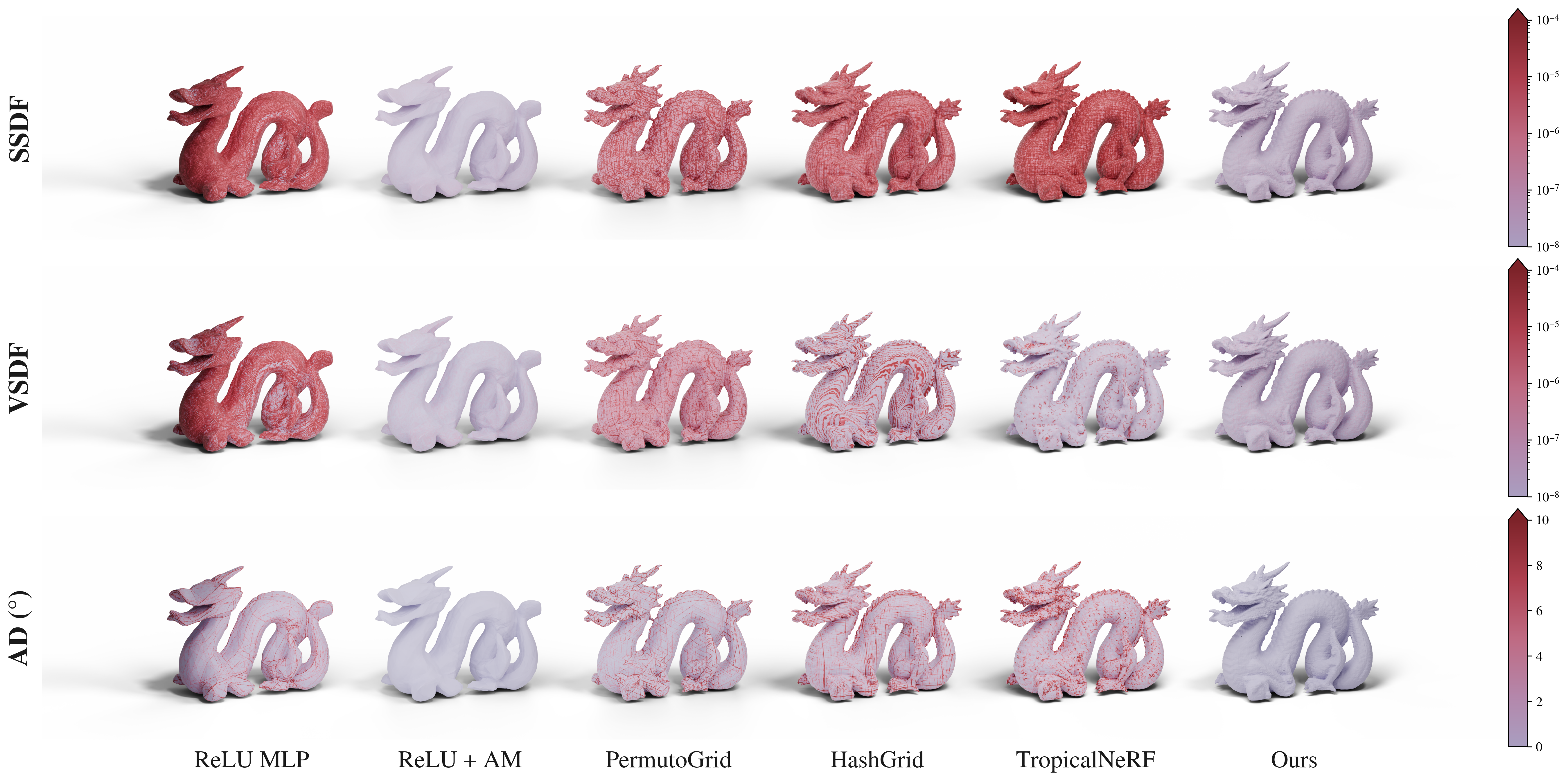
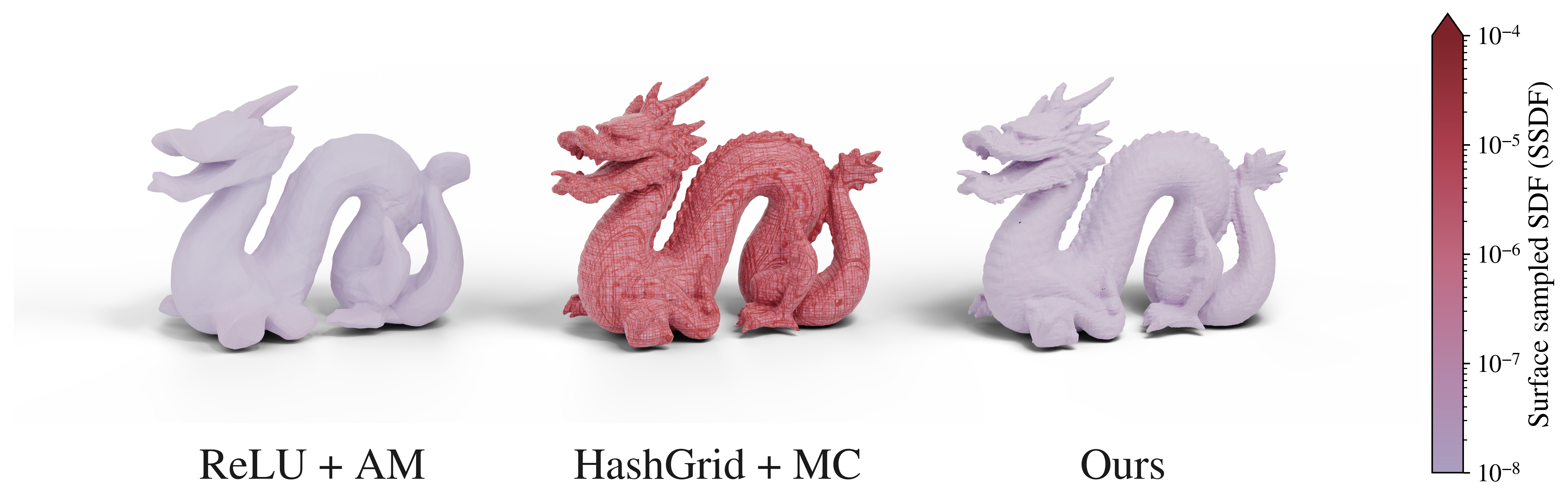
SSDF: the mean absolute SDF value predicted by the network at points sampled from the extracted mesh; ours reaches ≈ 1e-8, the scale of machine precision.

Abstract

Extracting an explicit surface that exactly matches the zero-level set of a neural signed distance function (SDF) remains challenging. Sampling-based isosurfacing methods such as Marching Cubes introduce discretization error. In contrast, continuous piecewise affine (CPWA) analytic approaches typically require plain ReLU MLPs, which limits the ability to learn high-frequency SDFs in practice. We present TetraSDF, an analytic isosurface extraction framework for SDFs that retains the expressiveness of grid-based encoders while enabling exact zero-level set extraction, by representing the SDF with a ReLU MLP composed with a multi-resolution tetrahedral positional encoder. Our positional encoder's barycentric interpolation preserves a global CPWA structure, allowing us to track ReLU linear regions within an encoder-induced polyhedral complex. We further introduce a fixed analytic input preconditioner derived from the encoder’s metric to reduce directional bias, thereby stabilizing training. Across multiple benchmarks, TetraSDF matches or surpasses existing grid-based encoders in SDF reconstruction accuracy, while faithfully recovering the network’s zero-level set as a triangle mesh.
Preliminary: Analytic Isosurface Extraction

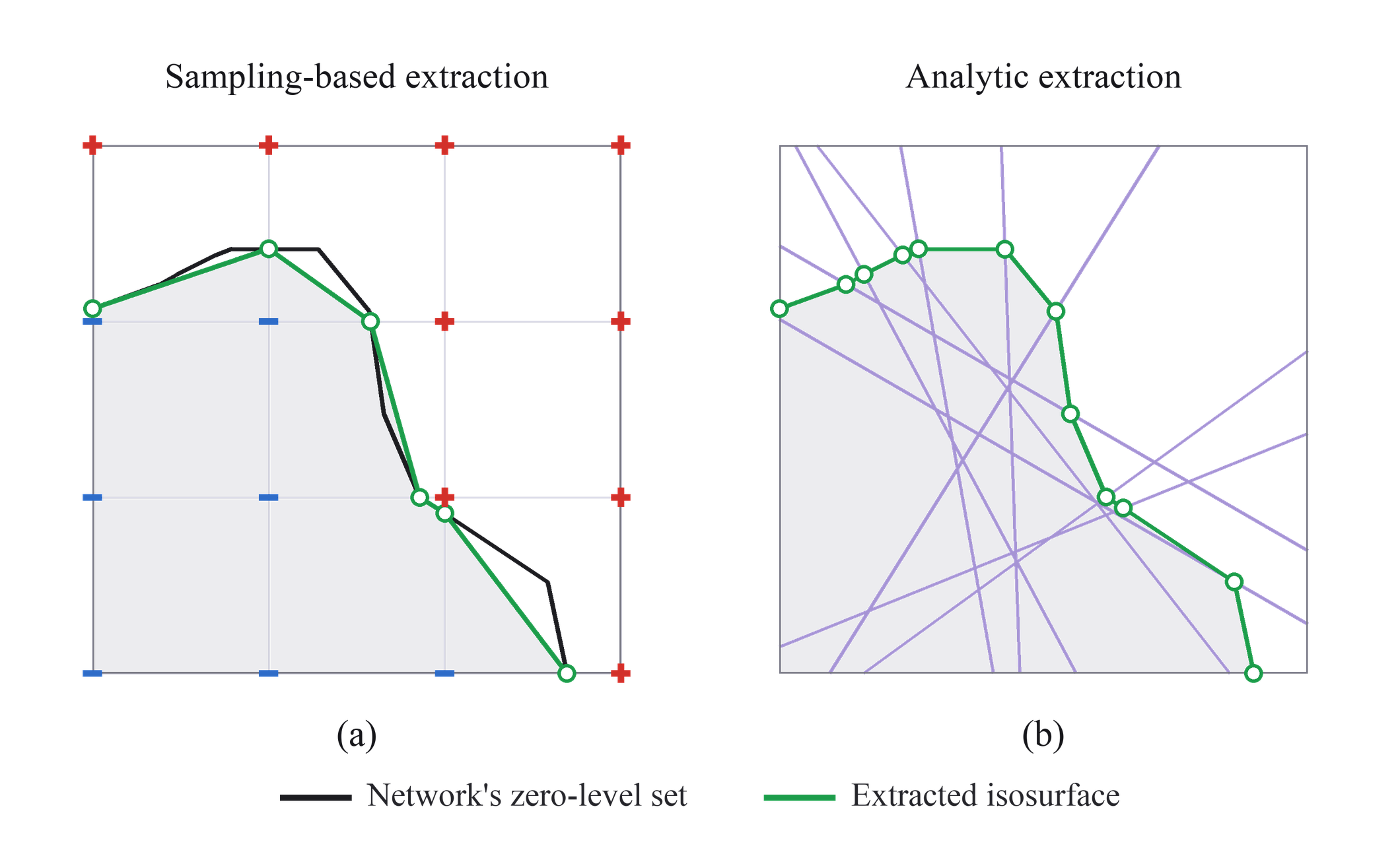
For a continuous piecewise affine (CPWA) network, the SDF is affine within each linear region, so its zero-level set bends only at region boundaries. Tracking these regions lets us place a vertex at every boundary crossing and recover the surface exactly. Sampling-based methods such as Marching Cubes instead rely on finite samples at fixed grid points to query the field, so the extracted mesh can drift from the trained network's zero-level set.

Sampling-based vs. analytic extraction of a curved isosurface.

Method

TetraSDF represents an SDF with a ReLU MLP composed with a multi-resolution tetrahedral positional encoder, keeping the overall mapping continuous piecewise affine (CPWA) so that its zero-level set can be extracted exactly as a triangle mesh.

Multi-resolution tetrahedral encoder

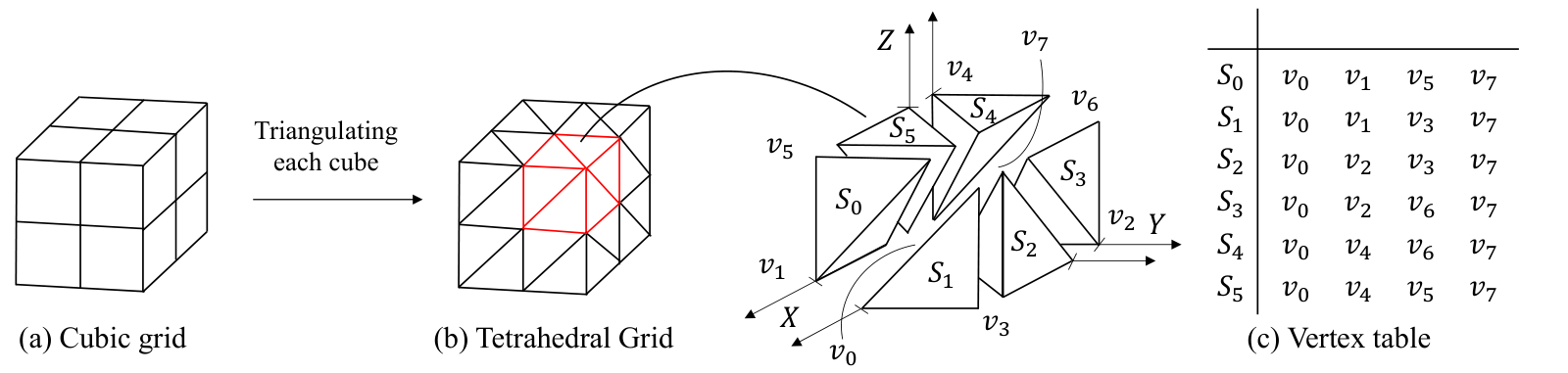
Multi-resolution tetrahedral grid encoder.

At each level, each cube cell is decomposed into six congruent tetrahedra, and barycentric interpolation within each tetrahedron keeps the encoder affine. The multi-level intersection of these tetrahedra forms a polyhedral cell on which a single affine piece of the CPWA mapping holds, preserving the global CPWA structure. Composed with a ReLU MLP, this encoder forms a tetrahedral network that is trained to fit the SDF.


Full pipeline

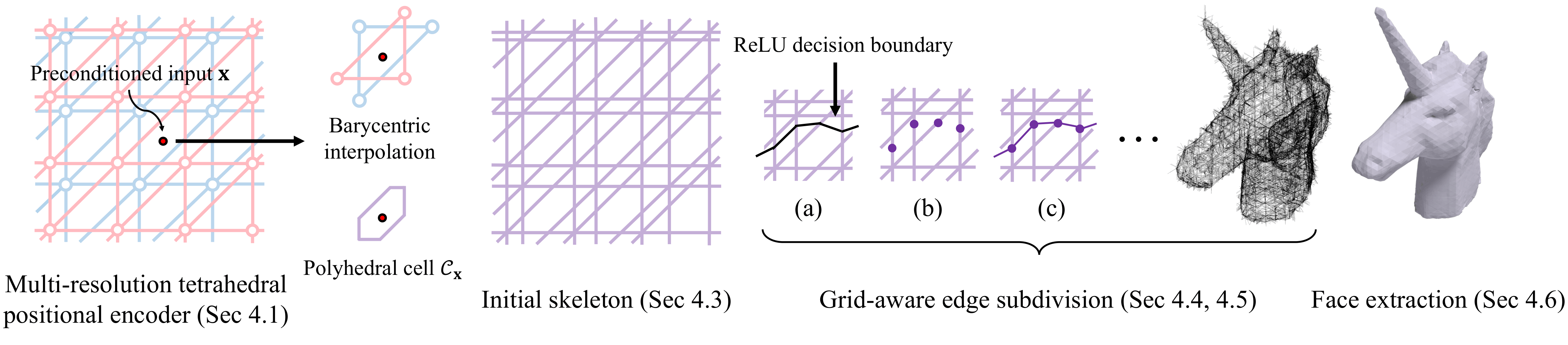
TetraSDF pipeline overview.

After training our tetrahedral network, an input x is mapped by the multi-resolution tetrahedral positional encoder to interpolated features within its containing polyhedral cell Cx. These cells form the encoder-induced polyhedral complex (the initial skeleton), from which we start edge subdivision. We then perform grid-aware edge subdivision that jointly tracks polyhedral cells and ReLU MLP linear regions to obtain the candidate vertex and edge sets (V, E), and finally extract mesh faces from (V, E) to obtain the final mesh. In (a)–(c), we zoom into a single edge subdivision iteration for a neuron.

Results

Ground-truth Accuracy

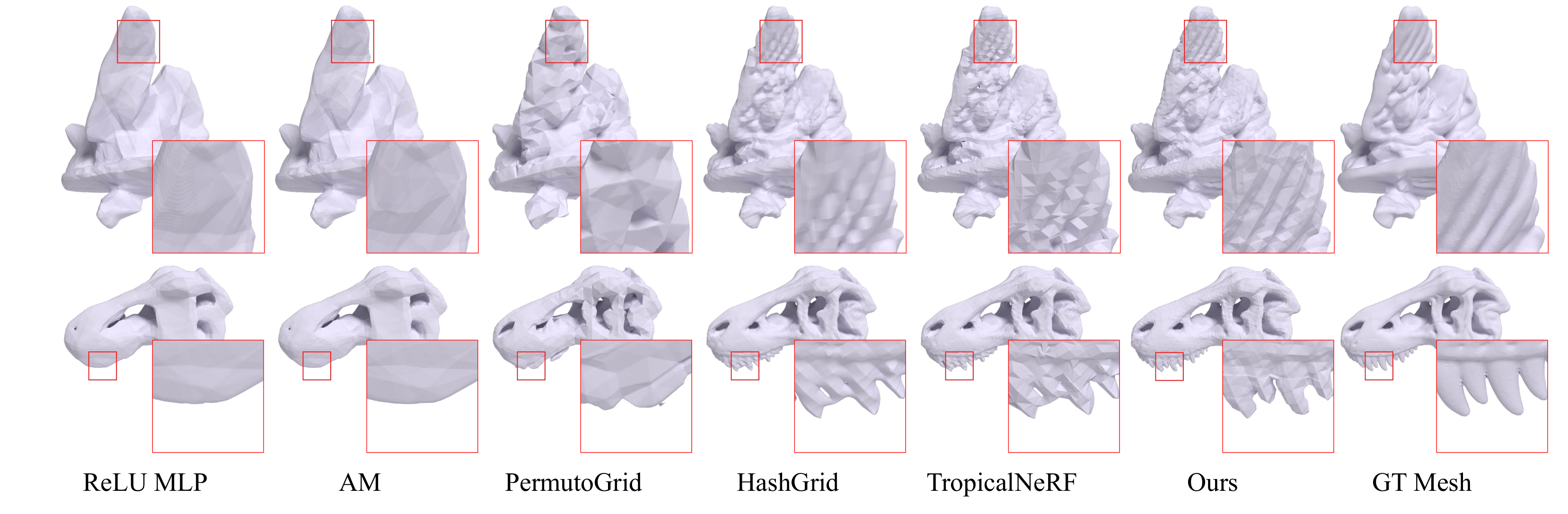
Qualitative reconstruction comparison against ground truth.

Qualitative comparison against the ground-truth mesh. TetraSDF matches or surpasses existing grid-based encoders in SDF reconstruction accuracy.


Self-consistency

Self-consistency measures how closely the extracted mesh agrees with the trained network's own zero-level set. We report it with three metrics: SSDF (Surface-sampled SDF), the mean absolute SDF the network predicts at points sampled on the mesh surface; VSDF (Vertex-sampled SDF), the same quantity evaluated at the mesh vertices; and AD (Angular Difference), the mean angle between the mesh normals and the network-derived normals. For all three, zero means the mesh lies exactly on the network's zero-level set. For ReLU MLP, PermutoGrid, and HashGrid we use MC512, while AM and TropicalNeRF use analytic extraction.

Self-consistency: SSDF, VSDF, and angular difference.

SSDF, VSDF, and AD for each method. Our analytic meshing makes our meshes exactly match the network's zero-level set, up to machine precision.


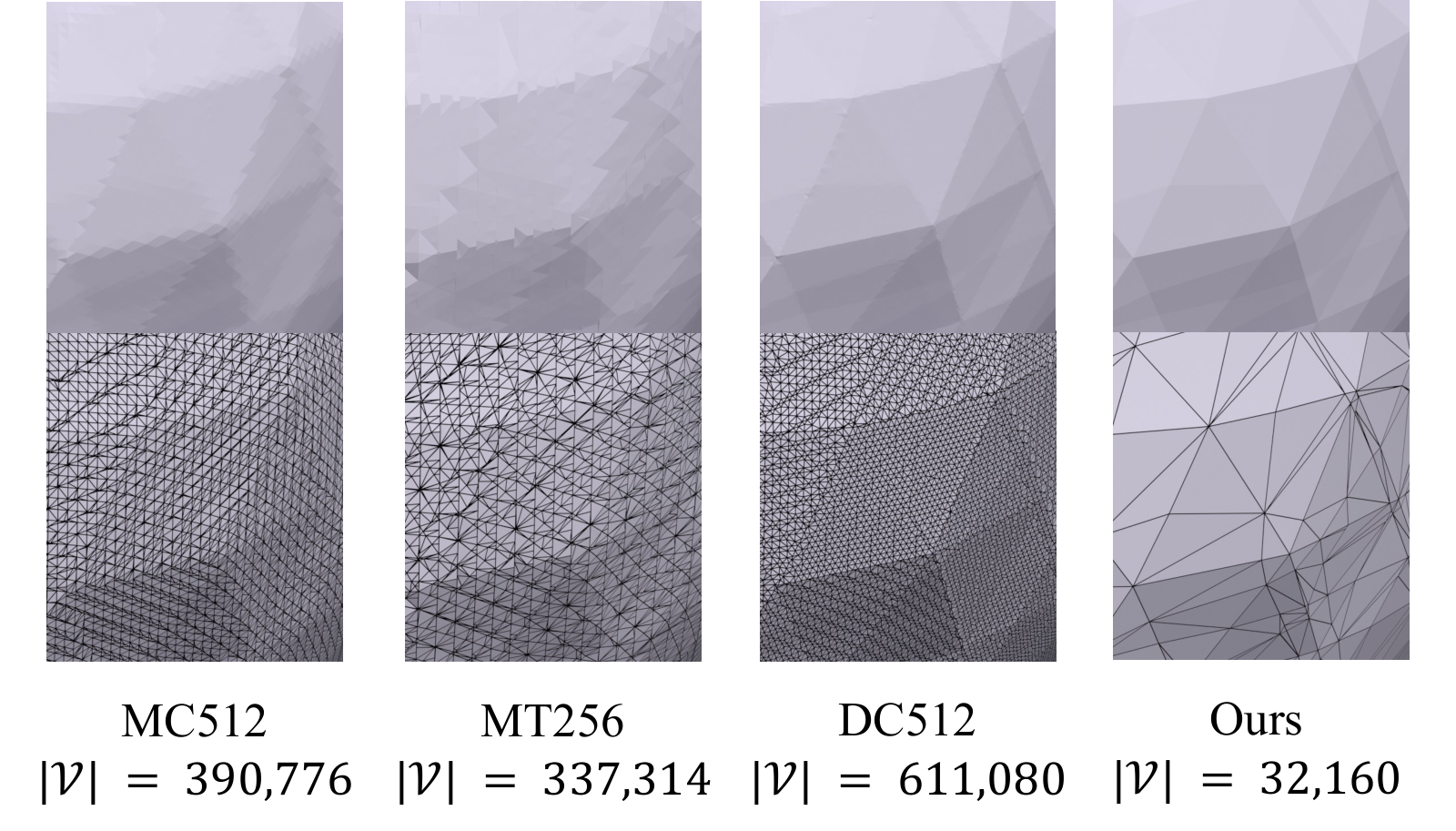
MC / MT / DC vs. ours, with vertex counts.

Sampling-based extractors (MC, MT, DC) need far more vertices to approach self-consistency, and even with a huge number of vertices they cannot become fully self-consistent, whereas ours achieves it with an order of magnitude fewer vertices.

BibTeX

@article{oh2025tetrasdf,
  title={TetraSDF: Precise Mesh Extraction with Multi-resolution Tetrahedral Grid},
  author={Oh, Seonghun and Uh, Youngjung and Kim, Jin-Hwa},
  journal={arXiv preprint arXiv:2511.16273},
  year={2025}
}